Beach Safety Guide
A plain-English guide to beach warning flags, rip currents, and what each warning actually means.
Flag color reference
Most beach warning flags follow the International Life Saving Federation standard, which is used in many countries — including across the United States, much of Europe, and Australia. The colors below are that standard, plus a few extras used by some U.S. counties.
Rip currents
Rip currents are narrow, fast-flowing channels of water moving away from shore. They are the leading surf hazard on beaches worldwide, and account for the large majority of lifeguard rescues. In Florida they kill more people each year than sharks, alligators, and hurricanes combined.
They can form on any surf beach — ocean, gulf, sea, or large lake — wherever waves break onto shore and the water needs a path back out.
How to spot a rip current
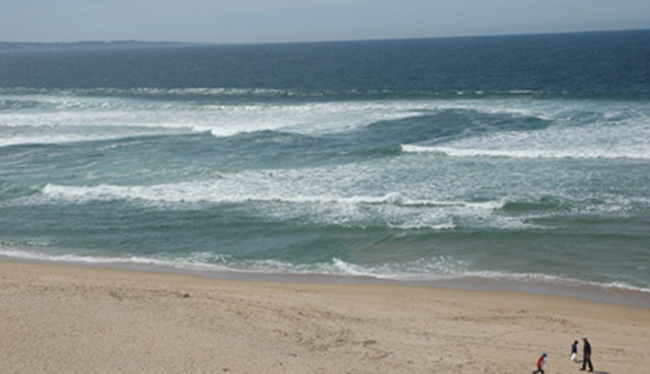
- A channel of noticeably darker, calmer water between sections of breaking waves.
- A line of foam, seaweed, or debris moving steadily out to sea.
- A break in the wave pattern — waves crash on either side but not in the middle.
- A different color water (often sandier) moving offshore.
If you get caught in one
- Don't fight it. A rip current can move at 8 feet per second — faster than an Olympic swimmer. Swimming straight back to shore against it will exhaust you.
- Stay calm and float. The current will carry you out, but it won't pull you under.
- Swim parallel to the shore until you're out of the rip (usually 30–100 feet).
- Then swim diagonally back to shore.
- If you can't escape, wave one arm and yell for help.
If you see someone else caught
Do not swim out to rescue them. Most rip current drownings involve a would-be rescuer. Throw them anything that floats (cooler, boogie board, life ring) and call emergency services (911 in the U.S., 112 in the EU) or signal a lifeguard immediately.
Surf height — what the numbers mean
- 0–2 ft — Calm. Safe for all swimmers.
- 2–4 ft — Moderate. Manageable for confident swimmers; tiring for children.
- 4–6 ft — Rough. Strong swimmers only. Significant rip current risk.
- 6+ ft — Dangerous. Most beaches will fly red or double-red. Stay out of the water.
Marine life
Which creatures you meet depends entirely on where you are. Jellyfish stings are the one hazard common to nearly every coast.
Anywhere:
- Jellyfish — sting on contact. Rinse with seawater (never freshwater, which can trigger remaining stingers to fire), remove tentacles carefully rather than rubbing, and apply vinegar if available. Seek medical help for widespread stings, or any difficulty breathing or chest pain.
Florida and the wider Caribbean / Gulf:
- Portuguese man-of-war — not technically a jellyfish but produces similar painful stings. Tentacles can remain venomous for hours after the animal is dead. Stings are rarely fatal but can cause severe reactions; seek medical help if symptoms include difficulty breathing or chest pain.
- Sea lice (jellyfish larvae) — invisible microscopic stingers that get trapped under swimwear, causing an itchy red rash hours later. Rinse, change out of swimwear, wash in hot water.
- Stingrays — usually buried in shallow sand. Shuffle your feet when entering the water — “the stingray shuffle” — to alert them to move out of your way.
Mediterranean and Adriatic:
- Jellyfish — the mauve stinger (Pelagia noctiluca) is the usual culprit, and blooms can arrive suddenly on a change of wind or current.
- Weever fish — small fish that bury themselves in shallow sand with venomous dorsal spines. Stepping on one is intensely painful. Beach shoes help; immersing the foot in water as hot as you can tolerate is the usual first aid.
- Sea urchins — common around rocks, breakwaters and harbour walls. Spines break off in the skin and can become infected.
Sun and heat safety
- Summer UV runs high on most beaches — 9–11+ in subtropical Florida for much of the year, and routinely 8+ around the Mediterranean in midsummer. Use SPF 30+ sunscreen, and reapply every 2 hours and after swimming.
- Sand and water reflect sunlight, so you burn faster at the beach than inland at the same UV index. Shade between roughly 11am and 4pm when the sun is highest.
- Drink water before you feel thirsty. Heat exhaustion creeps up fast.
- Watch for signs of heat illness: dizziness, headache, nausea, confusion. Get to shade, cool down, hydrate.
Lightning
When to swim
The safest time is when lifeguards are on duty (typically 9 AM to 5 PM, varies by beach). Never swim alone, at night, or after drinking.
Beaches that don't fly flags
Not every beach we track publishes lifeguard flags. Some — including our Italian beaches and a few sourced from forecast data — publish no flag at all. For those, Beach Watch never invents one. Instead it shows a few individual measurements (waves, wind, water temperature, UV) as coloured circles, each standing on its own.
Emergency contacts
If lifeguards are on duty, they are the fastest help available — go to the tower or wave for attention before anything else.
- United States — life-threatening emergency: 911
- Italy and the rest of the EU — life-threatening emergency: 112 (works across the European Union, from any phone, in multiple languages)
- U.S. Poison Control: 1-800-222-1222 (jellyfish stings, marine envenomation)
- National Weather Service Miami (South Florida surf and rip-current forecasts): weather.gov/mfl
Travelling elsewhere? Look up the local emergency number before you travel — it is rarely the one you use at home.